
Your body keeps the score of every unprocessed thought.Here's how to signal safety to your nervous system.
A 3-minute expressive writing protocol that moves stress out of your head and onto paper — so your body can finally stand down.
Get the journal on Amazon

Signs your nervous system is overwhelmed
Tired but wired
Exhausted all day, strangely alert at night. Your sleep rhythm feels upside down.
Emotional flooding
A message tone, a messy room or a change of plans hits you like an emergency.
Brain fog
When stress peaks, your memory and focus disappear exactly when you need them.
A body that never unclenches
Jaw, shoulders or stomach stay braced, even on a quiet Sunday.
Your stress system can't fully tell a real threat from a replayed one. When a worry loops, your brain keeps sending danger signals — and your body answers with the same chemistry: cortisol, adrenaline, shallow breathing. The calming “rest and digest” branch, carried largely by the vagus nerve, stays offline.
Chronic burnout is often this loop on repeat. Not one disaster — just a nervous system that never receives the all-clear, day after day.
Expressive writing gives the threat somewhere to go. Decades of research led by psychologist James Pennebaker link putting stressful experiences into words with better well-being, and brain-imaging studies show that simply naming an emotion calms the amygdala's alarm response. On paper, the storm becomes something you can look at — instead of something you're inside.
The 3-minute somatic download
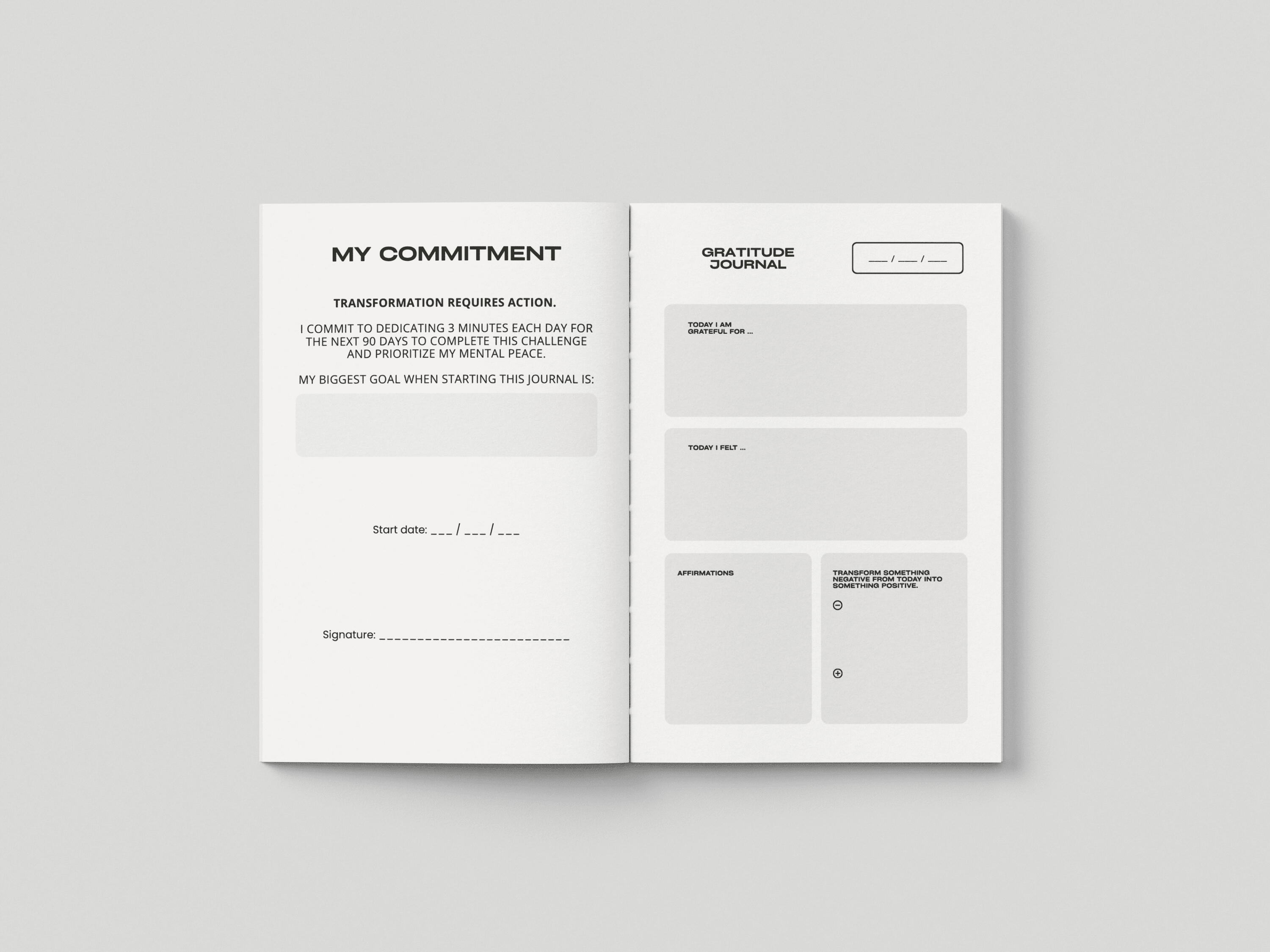
Use any paper to try it right now. These four steps map exactly onto the four boxes of every daily page in the 90-Day Gratitude Journal.
Before you write: three slow breaths with the exhale longer than the inhale.Locate
Where is today stored in your body? Jaw, chest, stomach? Write the place and one word: “Chest — tight.”
Offload
Dump the loop, unedited. Then one line: “What is actually in my control right now?”
Collect safety
List three moments your body felt safe today: a warm shower, sun on your face, a real laugh.
Signal
Write a sentence your body can hear: “I am safe right now. I'm allowed to rest.”
Built for a depleted nervous system
One-Sitting Method
A 3-minute somatic discharge — short enough that it never becomes one more thing that overwhelms you.
Open-Space Design
No rigid lines, no word counts, no performance. Journaling that lowers the load instead of adding to it.
90-Day Challenge
Nervous systems learn through repetition. One page a day, ninety days of safety signals.
Small pages. A visible change.
Your first download. You sign your commitment to 3 minutes a day.
You start noticing where stress lands in your body — before it floods you.
A written map of your triggers, patterns and recoveries — in your own handwriting.
Not another journal you'll abandon
Typical journals
- Blank pages that stare back
- 15–20 minute prompts
- Guilt when you miss a day
- One more thing to perform
The 90-Day Journal
- Four calm, guided boxes
- About 3 minutes
- A fresh page — no streaks
- A private space to unload
Before you decide
Is this somatic therapy?
No. It's a journaling tool informed by research on expressive writing and emotion labeling. For trauma, please work with a qualified professional.
Will it lower my cortisol?
We don't promise medical outcomes. Research links expressive writing and gratitude practices with lower perceived stress and better sleep — this journal simply makes the practice easy to repeat.
I'm too exhausted to journal.
That's exactly who it was designed for: four boxes, three minutes, no rules.
Morning or night?
Either. At night it helps you offload before sleep; in the morning it sets a calmer baseline.
What exactly is inside?
A 96-page paperback: a short guide to the 3-minute routine, a signed commitment page, 90 identical daily pages (Today I am grateful for · Today I felt · Affirmations · Transform something negative into something positive) and a final reflection to see how far you've come.
Is this a replacement for therapy?
No. It's a personal development tool, not medical or psychological treatment. If you're struggling, please reach out to a qualified professional. Many people use the journal alongside therapy.
Give your nervous system a daily all-clear.
Three minutes a day. Ninety days of signals that you're safe.
Get the journal on Amazon